“There is no ache more deadly than the striving to be oneself.”
– Yevgenily Vinokurov
Who am I? What is the purpose of life? Why am I here? What is it that makes me who I am? How do I just be my real self? Do these questions sound familiar to you? As clinicians, these are the questions we hear from our clients throughout their recovery journey. These are even questions that we have pondered ourselves throughout our lifetime. As we know, these are not easy questions to answer and supporting our clients towards answering these questions for themselves is a large part of attaining what we call “emotional recovery.” Without emotional recovery, our clients become complacent and stagnant in their recovery, and are at risk for relapse.
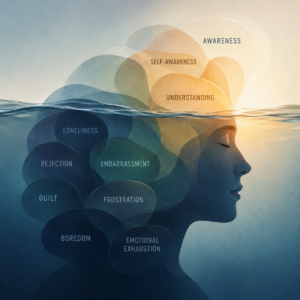
That deadly ache that Yevgenily Vinkurov refers to is the ache that can kill the spiritual center of our human existence if we do not delve inside of it to find our “real self.” According to Masterson (1988), “the real self, from the perspective of object relations theory, is made up of the sum of the intrapsychic images of the self and of significant others, as well as the feelings associated with those images, along with capacities for action in the environment guided by those images. The images of the real self are derived mostly from reality and to a lesser extent from fantasy — what one wishes as well as what one is — and its motives are directed toward master of reality tasks as a way of maintaining psychic equilibrium.” The challenge with operating from the real self is due to the development of the false self. The false self is created mostly from infantile fantasies. Rather than operating from a reality perspective the false self operates based on internalized ideas and emotional states that were experienced during our formative years of development. “The false self’s motives have nothing to do with dealing with reality tasks but to implement defensive fantasies by avoiding self-activation to promote maladaptive ways of being taken care of. The purpose of the false self is not adaptive but defensive; it protects against painful feelings. In other words, the false self does not set out to master reality but to avoid painful feelings, a goal it achieves at the cost of mastering reality (Masterson, 1988).”
It is interesting how James Masterson’s description of the false self is also the motives of addiction: “to avoid painful feelings at the cost of mastering reality.” To move out of the false self and operate from the real self requires a journey of grief and loss. Coming to the painful reality that we have been grieving from the moment we were born is no easy task. Inside the grief of the false self lies a loss that is filled with anxiety. This anxiety is what propels depression, despair, abandonment, loneliness, sadness, false sense of responsibility, helplessness, feeling unlovable, and hopelessness. These feelings are the fuel that gives fire to the development of addiction.

Our false self must be understood, unraveled and healed by coming to acceptance, feeling what happened in our past and breaking up the distortions that were internalized upon the “self.” Lastly, we must take action to change the reflection within ourselves as well as our environment and interpersonal relationships to access and live from within our “real-self.”
One of the things I admired and respected the most about my graduate program was their encouragement to be involved in my own therapeutic process. Essentially their message was “you are a fraud and a hypocrite if you think you’re going to help someone when you don’t know what it’s like to sit in the chair and be the client and really know how uncomfortable it is to reveal yourself, to process your grief and to really look within yourself and your mind.” The investment in my own therapy has been the best education I have ever received when it comes to being a clinician. It is a our responsibility as clinician to have an understanding of our minds so that we can help our clients navigate their false selves and obtain the reward of being in the “real-self.”
Let us not forget that the journey of emotional recovery for addicts in recovery is imperative. Without it, we know, the ends are always the same “jails, institutions, and death.”
Let’s make a commitment to be the best we can be for our clients, which requires us to do the very work we ask our clients to do!!!
Sarasota Addiction Specialists thanks all of you for your continued support and your commitment to help others achieve freedom, hope and life from active addiction!!!
For more information please visit our website at www.sarasotaaddictionspecialists.com
Thank you,
Dr. Kimberly S. Benson LMHC, CAP, CCTP